
Clearfield County Court Records After a Jail Arrest
Clearfield County’s court records after a jail arrest usually begin with police or Pennsylvania State Police activity, a magisterial district judge proceeding, and a charging decision. Local MDJs preside over arraignments, fix and accept bail, issue warrants, hold preliminary hearings, and act as committing judges. Once a person is committed to the Clearfield County Jail or released under court conditions, public case information normally appears through MDJ docket entries, Court of Common Pleas docket entries, or both.
The Clearfield County District Attorney prosecutes the county criminal case after the arrest. DA Ryan P. Sayers oversees an office that coordinates with four Pennsylvania State Police barracks and three municipal police departments, and the office reports prosecuting more than 1,200 criminal cases each year. The arrest and booking record is not the same as the court record: jail inmate records deal with custody and commitment, while the docket shows charges, bail, hearings, dispositions, and sentence events.
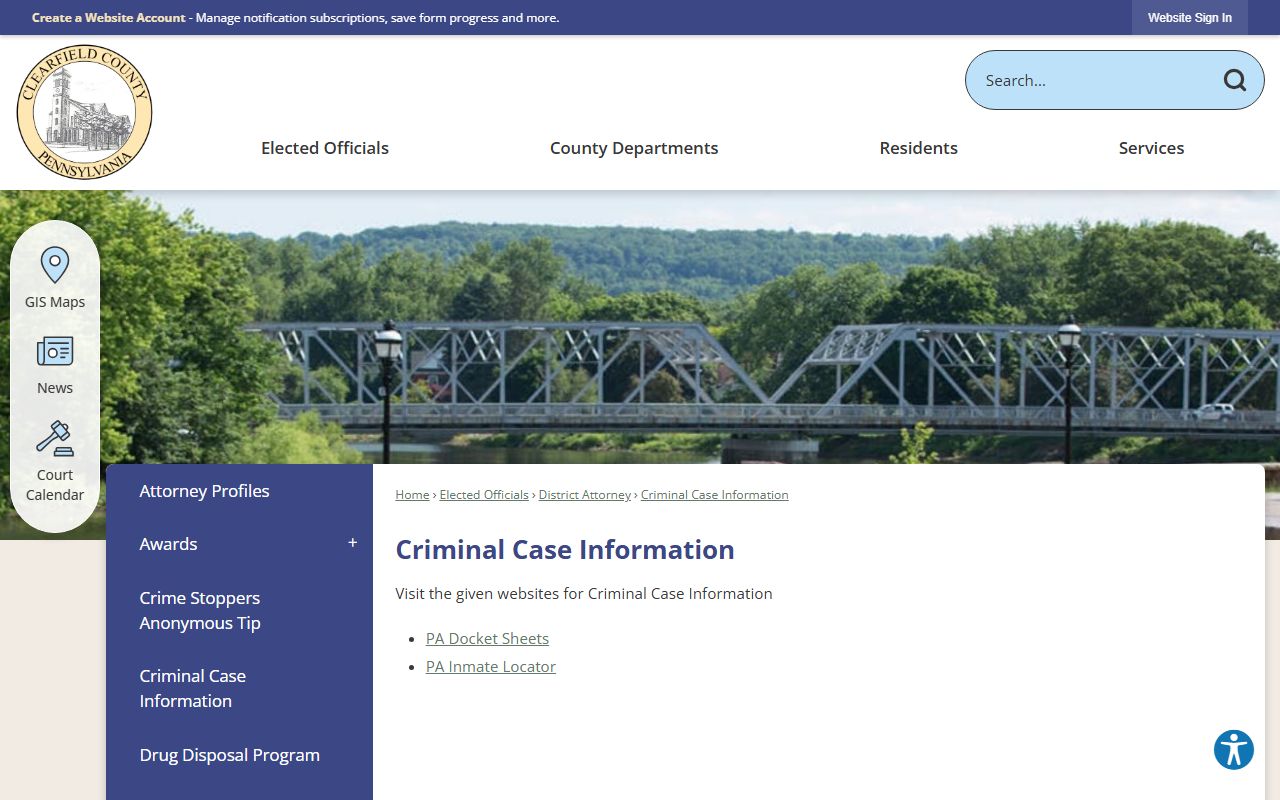
For official criminal docket searching, use the statewide Unified Judicial System portal. The Clearfield County District Attorney’s criminal-case information page sends readers to PA Docket Sheets and the PA Inmate Locator, which is an important distinction. UJS is for charges and court events after an arrest; the PA DOC locator is for sentenced state custody; the county jail phone and VINE/SAVIN are for immediate custody-status questions.
How to Find Clearfield County Court Records After an Arrest
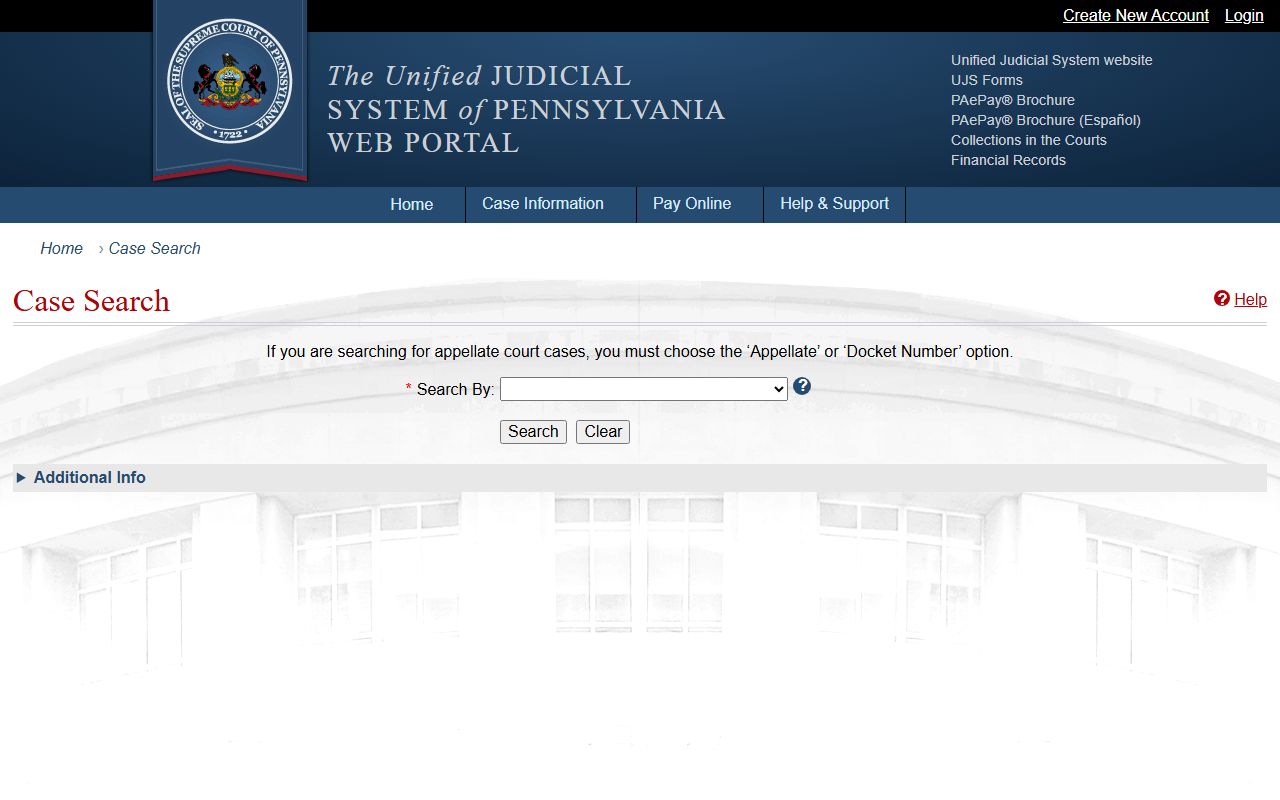
Start with the Pennsylvania UJS Case Search portal when the goal is to find court records after an arrest in Clearfield County. The portal supports participant-name searching and several identifiers that may appear on police paperwork, bail papers, citations, or docket sheets. Narrowing the search to Clearfield County or Judicial District Clearfield - 46 helps separate local criminal cases from similar names in other Pennsylvania counties.
- Open UJS Case Search and choose the search type that matches what you know, such as Participant Name, Docket Number, OTN, Complaint Number, Citation Number, Incident Number, Date Filed, Calendar Event, Attorney, Organization, SID, or other portal options.
- Use the person’s full name if no docket number is available, then filter by County Clearfield or Judicial District Clearfield - 46.
- Check both MDJ and Common Pleas results. Felony and misdemeanor cases often start at an MDJ office and move to Common Pleas after a preliminary hearing or waiver.
- Open the docket sheet and read each charge, grading, docket entry, bail entry, scheduled hearing, disposition, sentence event, and financial entry separately.
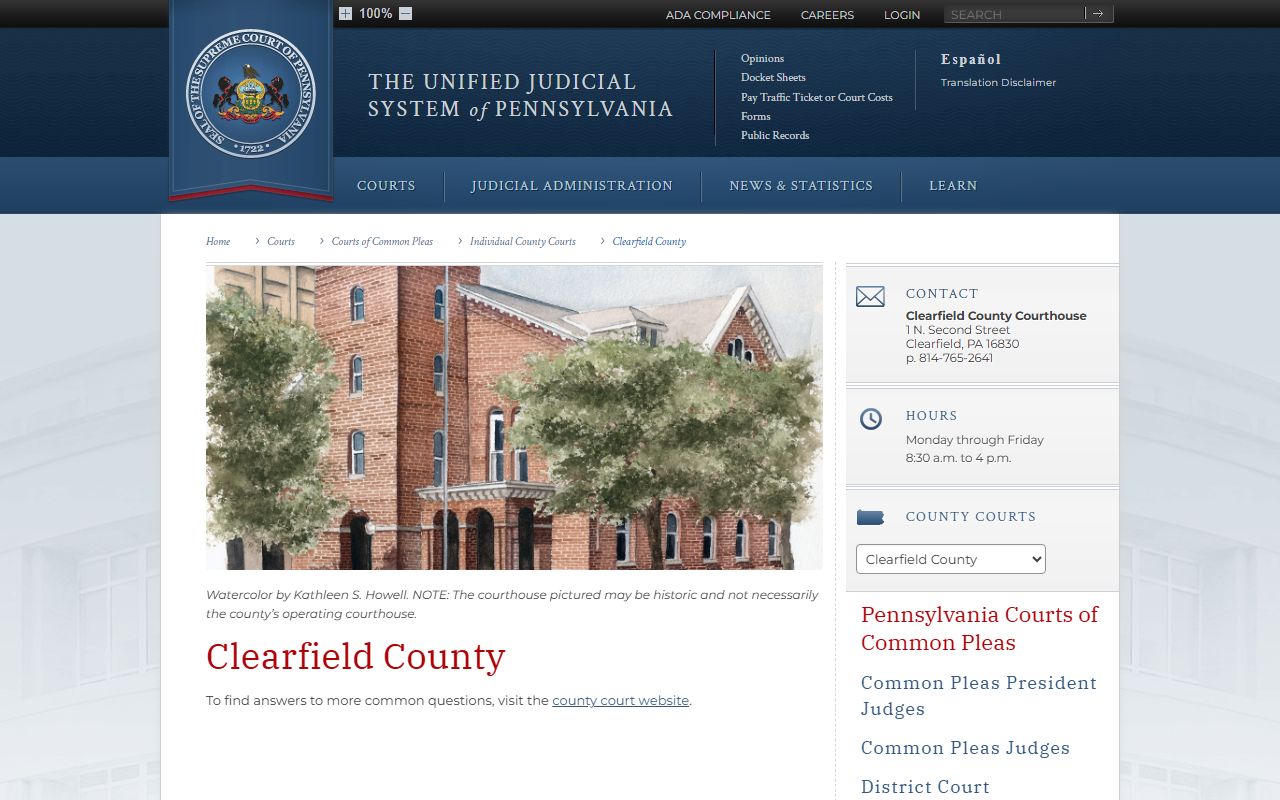
UJS search fields documented for Clearfield County include Docket Number, Citation Number, FID, SID, SSN, Date Filed Start Date, Date Filed End Date, County, Judicial District, and MDJS Court Office. Clearfield County MDJ offices include DuBois, Clearfield, Kylertown, and Houtzdale. For in-person court needs, the Clearfield County Court of Common Pleas is at 1 N. Second Street, Clearfield, PA 16830, with county office hours listed as Monday through Friday, 8:30 a.m. to 4 p.m.
The Pennsylvania UJS Case Search portal is the official statewide starting point for docket sheets after a Clearfield County arrest.
How Charges Get Filed After an Arrest: Complaint, Information, and Indictment
Booking at the jail records custody; the charging document begins the court case. In Pennsylvania practice, the criminal complaint is commonly the first public charging document at the MDJ level. If charges are held for court or waived forward, the District Attorney may file a criminal information in the Court of Common Pleas. An indictment is a grand-jury route and should not be assumed for an ordinary Clearfield County case unless the docket shows it.
| Document | Usually Filed By | Common Use | What to Check |
|---|---|---|---|
| Criminal complaint | Police officer or prosecutor | Initiates many MDJ criminal cases after arrest or summons | Complaint number, OTN, charge list, affidavit references, filing date |
| Criminal information | District Attorney | Formal Common Pleas charging document after the case moves forward | Whether charges match, change, or narrow from the MDJ docket |
| Indictment | Grand jury process | Less common for ordinary county cases | Use only if the docket or filing specifically identifies an indictment |
The Clearfield County District Attorney criminal-case information page links users to PA Docket Sheets and the PA Inmate Locator, reflecting the split between court records and custody records.
Charge Status and What It Means
Charges can change after a Clearfield County jail arrest. A booking entry may reflect what the arresting agency alleged at intake, while the court record reflects what the prosecutor files and what the court does with each count. A docket should be read count by count because one charge can be held for court while another is withdrawn, amended, reduced, dismissed, or resolved by plea.
| Status | What It Means |
|---|---|
| Pending | The charge has not reached a final court outcome. |
| Held for court | The MDJ sent the charge forward to the Court of Common Pleas, often after a preliminary hearing or waiver. |
| Withdrawn / dismissed | The charge did not proceed, either because it was withdrawn by the prosecution or dismissed by the court. |
| Amended / reduced | The wording, grading, statute, or severity changed from an earlier version. |
| Guilty / nolo / not guilty | The docket is recording a plea or verdict outcome, not just an accusation. |
| Sentence / disposition | The court has entered a result for the count or case, which may include sentence terms, costs, or supervision. |
Bail, Bond, and Release After an Arrest
Clearfield County bail decisions at the early stage are tied closely to the magisterial district judge system. MDJs preside over arraignments and can fix and accept bail, so the first bail entry may appear on an MDJ docket before the case reaches Common Pleas. To confirm current release status, search UJS, call the Clearfield County Jail at 814-765-7891, and contact the relevant MDJ office when the docket identifies one.
| Bail Type | How It Works |
|---|---|
| ROR / recognizance | Release based on the person’s promise to appear, without upfront money. |
| Nonmonetary conditions | Release with court conditions such as reporting, no-contact orders, supervision, treatment, or travel limits. |
| Unsecured bail | No immediate deposit is required, but a stated amount may become owed if the person fails to appear. |
| Percentage or cash bail | The court may require money to be posted. Confirm the exact amount, place, and payment method from the docket or court. |
| Surety | A surety may secure release when the court order allows that path. |
| No bail or hold | A detainer, warrant, parole issue, federal matter, ICE custody, or court order can prevent release even when one charge has bail. |
Warrants That Lead to an Arrest
No official Clearfield County Sheriff active-warrant search database was located on the county site. Warrant research should start with UJS docket entries and the issuing court. Search by participant name, docket number, OTN, complaint number, citation number, or incident number, then look for entries such as bench warrant, warrant issued, warrant lifted, bail revoked, failure to appear, or commitment. The Sheriff’s Office can be relevant to transport and service questions at 814-765-2641 Ext. 5015, but current custody after a warrant arrest should be confirmed with the jail.
Clearfield County lists MDJ offices in DuBois, Clearfield, Kylertown, and Houtzdale. If a docket identifies the issuing office, contact that court for official instructions rather than relying on a third-party warrant page. Search warrants and sealed warrant materials may not be public while an investigation is active. Fugitive or out-of-county warrants can also create a Clearfield County jail booking before transfer or extradition.
Charges vs. Convictions
An arrest, a jail booking, and a filed charge are not the same as a conviction. Court records after a jail arrest may show accusations long before the case is resolved. A conviction exists only when the docket reflects a guilty plea, nolo contendere plea, guilty verdict, or other qualifying disposition for that specific charge.
| Charge | Conviction | |
|---|---|---|
| Stage | Accusation filed in court after arrest or summons | Final result by plea, verdict, or qualifying disposition |
| Proof level | Can begin with probable cause or charging decision | Requires the legal standard for conviction or an accepted plea |
| Docket reading | Review status, amendments, withdrawal, dismissal, and held-for-court entries | Review disposition and sentence entries for each count |
| Practical warning | Do not treat an open charge as guilt | Confirm that the charge, not just the case, reached conviction status |
Sealed vs. Expunged Arrest Records
Pennsylvania record restrictions depend on statute, case type, disposition, and court order. Clearfield County’s public-record materials recognize that sealed cases or documents, juvenile records, and mental-health records are not public in comparable court-record contexts. For criminal cases, expungement analysis belongs under Pennsylvania CHRIA and related law, including 18 Pa.C.S. Section 9122.
| Sealed | Expunged | |
|---|---|---|
| Public visibility | Hidden from ordinary public access, while the record may still exist for permitted users. | Removed or treated as cleared under the governing expungement order and statute. |
| Law enforcement access | May remain available to courts or criminal justice agencies under limited rules. | Access is more restricted and depends on the order and applicable law. |
| Typical trigger | Confidentiality rule, juvenile status, sealed filing, or court order. | Dismissed, withdrawn, ARD, age-based, or other eligibility evaluated under Pennsylvania law. |
| What to do | Ask the originating court what order controls access. | Review 18 Pa.C.S. Section 9122 and consider legal advice before filing. |
Court Records Requests and Public Terminals
Free docket sheets are available through UJS, but a person may still need a certified copy, a file review, or a specific court record that is not fully available online. The UJS Clearfield County Court of Common Pleas page lists court links, docket sheets, public records, PAePay, and court contact information. Clearfield County’s Prothonotary/Clerk of Courts materials also discuss public terminal access and exclusions for sealed, juvenile, and mental-health materials.
The UJS Clearfield County Court of Common Pleas page gives the courthouse contact point for court-record access beyond a simple docket search.
Background Check Considerations
Casual docket searching is different from a legally compliant background check. UJS docket sheets can help identify court records after an arrest, but employment, housing, credit, insurance, licensing, and similar decisions can trigger federal and state screening rules. Pennsylvania CHRIA also regulates criminal history record information, including dissemination to individuals and noncriminal justice agencies.
Important: The material presented is not a consumer report and must not be used for FCRA-covered decisions.
Restricted Court Records After an Arrest in Clearfield County
Not every arrest-related record is public. Juvenile matters, sealed court documents, mental-health records, confidential filings, investigative materials, certain victim information, and expunged records may be unavailable or only partly visible. If a UJS search does not show the expected court records after a jail arrest, the reason may be timing, spelling, a different county or judicial district, a case still at the MDJ stage, a transfer to another custody system, or an access restriction. Use the originating court or records officer to verify the record rather than assuming no case exists.
Public Record Search
Sponsored Results